
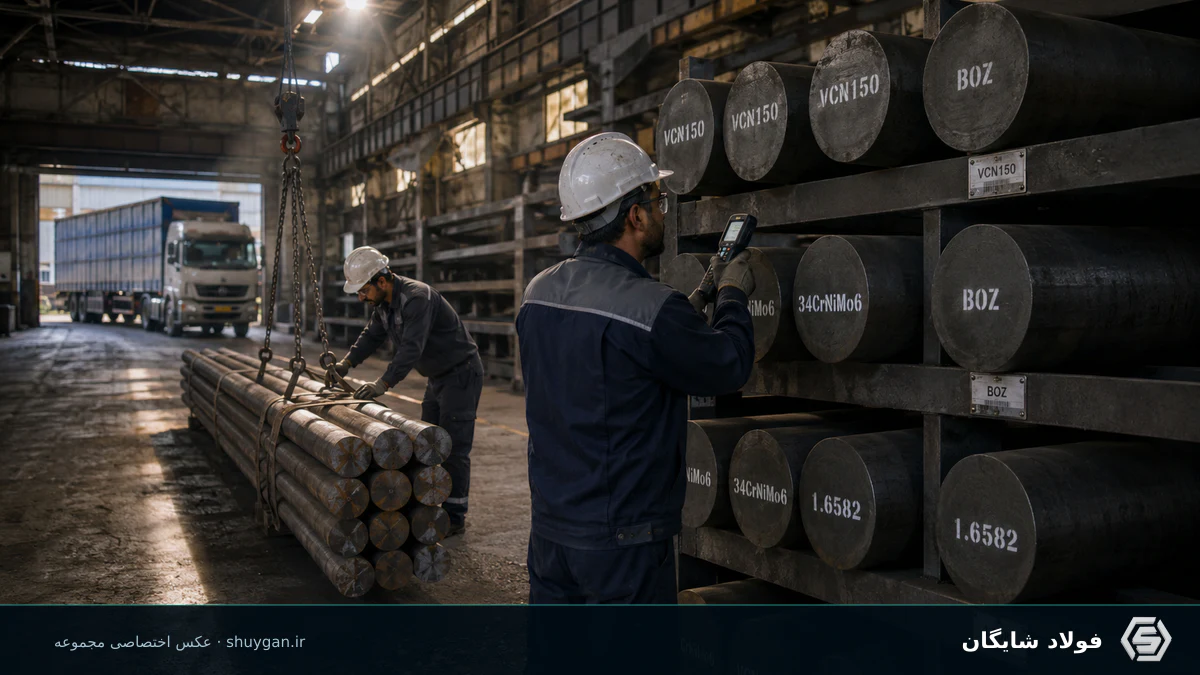
A Tehran name and a Tabriz name: what must the document say?
Why Tehran buyers may call 1.6582 VCN150 while Tabriz buyers say BOZ, and how to verify 34CrNiMo6 identity, condition and documents before purchase.
VCN150 and BOZ are regional trade expressions used for high-strength nickel-chromium-molybdenum steel. The engineering identity normally sought is 34CrNiMo6 / 1.6582, but the verbal name must be converted into a documented grade, product form and delivery condition.
This guide is intended for designers, buyers, heat-treatment teams and workshops supplying parts across Iran. It translates a familiar market enquiry into requirements that can be checked before payment, cutting, machining or furnace work.
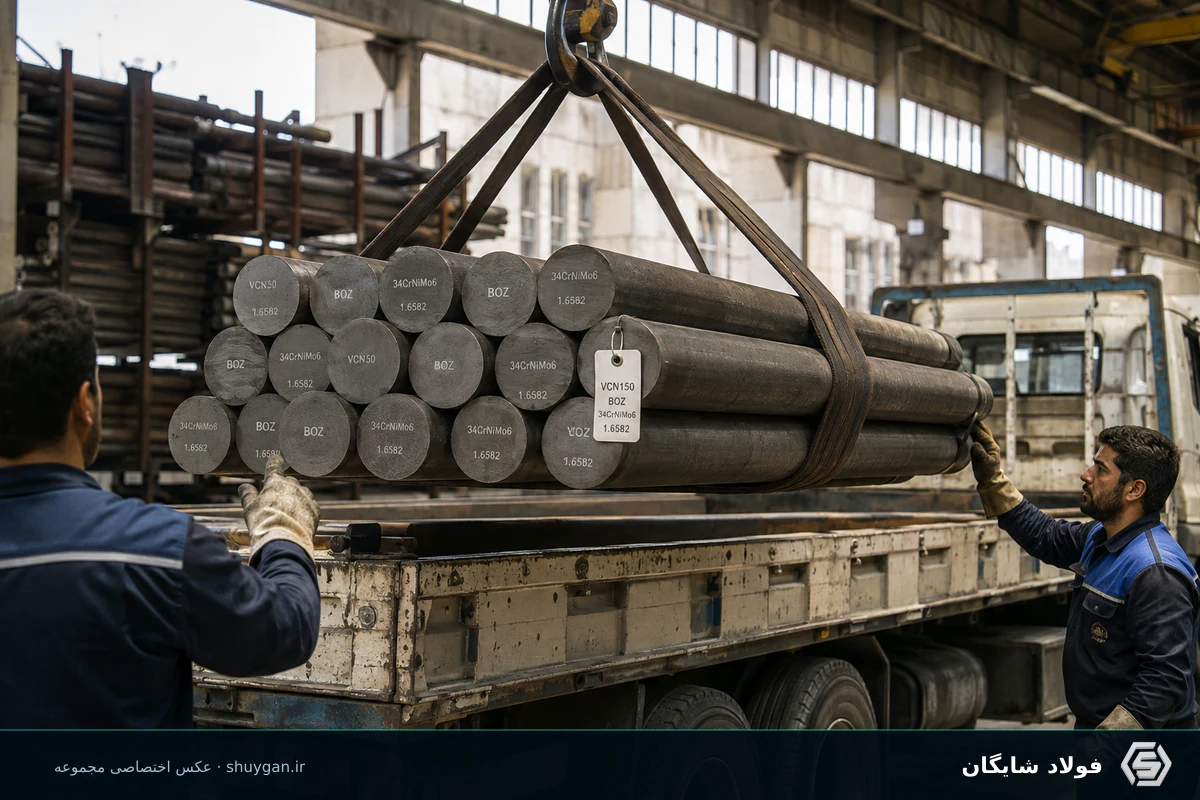
Quick decision map
| Question | Why it matters | Required evidence |
|---|---|---|
| Regional trade name | Explains how the enquiry was expressed | VCN150 or BOZ recorded beside 34CrNiMo6 / 1.6582 |
| Section and core duty | Large diameters need strength and toughness through the effective section | Final geometry, load and critical property location |
| Delivery and heat treatment | Annealed and Q&T material support different production routes | Condition, hardness range and planned downstream cycle |
| MTC and heat number | Prevents a familiar nickname from replacing evidence | Matching identity, chemistry, tests and piece marking |
Identity, standard and the real engineering question
For a critical shaft or heavily loaded part, identify 34CrNiMo6 / 1.6582, the ordered standard, section size, heat-treatment state and heat number. These fields prevent VCN150 from being confused with VCN200 or another high-strength grade.
34CrNiMo6 is selected where a combination of hardenability, strength and toughness is required, particularly in shafts and highly stressed machine parts. The benefit depends on section, heat treatment and the property location specified by design.
Regional trade name
Explains how the enquiry was expressed. Record VCN150 or BOZ recorded beside 34CrNiMo6 / 1.6582 before commercial comparison begins. If this field remains verbal, purchasing, production and inspection can each interpret the same requirement differently.
Section and core duty
Large diameters need strength and toughness through the effective section. The order should therefore require Final geometry, load and critical property location. Catalogue data becomes useful only after product form, section and test condition are made comparable.
Section, process and delivered condition
Section size changes cooling rate, property distribution, sampling position and sometimes the applicable property range. Product form also matters: bar, plate and forging may share a grade name but follow different dimensional, testing and delivery requirements.
VCN150 and VCN200 are not interchangeable labels. Ask for the material number and actual standard on the certificate; if 1.6580 is offered instead of 1.6582, treat it as an engineering substitution requiring approval.
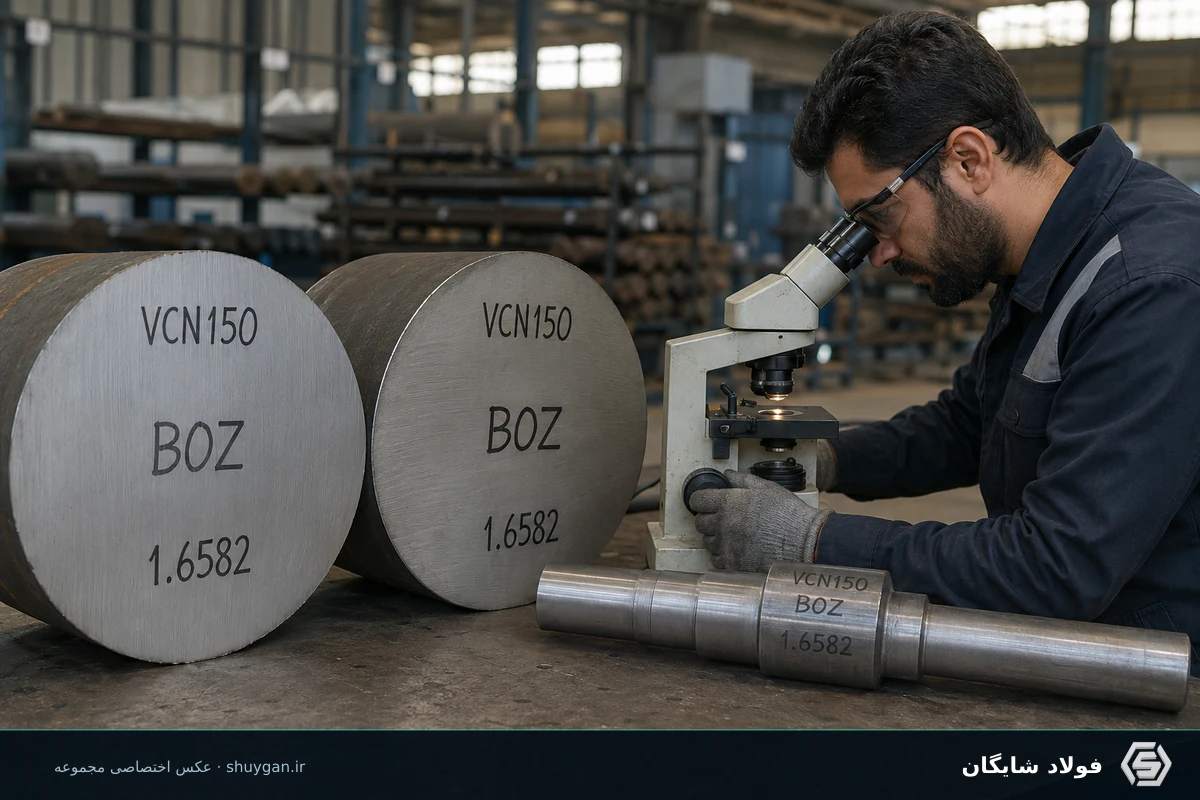
Inspection evidence that closes the decision
Evidence should answer a defined question. An MTC records heat identity and declared results; a process record proves the route used; a supplementary test report proves a result at a stated location. None of them should be treated as a substitute for the other two.
Delivery and heat treatment
Annealed and Q&T material support different production routes. Define Condition, hardness range and planned downstream cycle and identify the point where production must stop if the evidence is missing or outside the agreed range.
MTC and heat number
Prevents a familiar nickname from replacing evidence. Release should be based on Matching identity, chemistry, tests and piece marking, attached to the same heat and piece identity. A valid test report has limited conformity value after traceability has been lost.
A defensible purchase specification
State 34CrNiMo6 / 1.6582, bar or forged-product dimensions, delivery condition, required inspection document, heat-number transfer after cutting and the mechanical-property location relevant to the part.
Grade/material number: [complete]; standard and edition: [complete]; form and dimensions: [complete]; delivery condition: [complete]; quantity and cutting tolerance: [complete]; MTC type: [complete]; supplementary test and acceptance rule: [complete]. Topic-specific requirement: State 34CrNiMo6 / 1.6582, bar or forged-product dimensions, delivery condition, required inspection document, heat-number transfer after cutting and the mechanical-property location relevant to the part.
Ordering checklist for Tehran, Tabriz, Isfahan and Yazd
- Write the recognised market term, but place VCN150 or BOZ and the documented designation on the same enquiry.
- Close Regional trade name with VCN150 or BOZ recorded beside 34CrNiMo6 / 1.6582.
- Close Section and core duty with Final geometry, load and critical property location.
- Define Delivery and heat treatment before irreversible processing.
- Keep MTC and heat number traceable through cutting, storage and loading.
- State destination, required dispatch date, packaging, piece count and who authorises release.
Related encyclopaedia pages and guides
- 34crnimo6 1 6582
- 30crnimo8 1 6580
- Previous Week-01 technical guide
- Next Week-01 technical guide
- Alloy-steel encyclopaedia
- Evidence and calculation methodology
- Contact Shaygan Steel
Frequently asked questions
Is every BOZ steel 1.6582?
No. BOZ is a market expression; the certificate must identify 34CrNiMo6 / 1.6582 and the agreed product standard.
Is VCN150 best for every shaft?
No. Load, diameter, fatigue details, heat treatment, machining and failure consequence determine whether the grade is justified.
Can 1.6580 replace 1.6582?
Only after comparing chemistry, hardenability, ordered properties, section and process route and obtaining responsible technical approval.
Sources and method
This article uses the official references below as technical orientation and translates them into a procurement workflow for the Iranian market. A producer data sheet applies to the product and conditions it states; it does not replace the current purchase standard, drawing or MTC for the delivered heat.
- Steel-Iron-List — official technical reference
- Ovako Steel Navigator — official technical reference
- ISO 10474:2013 — official technical reference
Conclusion and next step
Use VCN150 or BOZ to communicate with the market, but accept the material only through the documented identity 34CrNiMo6 / 1.6582 and traceable condition-specific evidence.
For an enquiry, send material number, form, raw and final dimensions, quantity, delivery condition, inspection needs and destination in one message. Shaygan Steel can then review the evidence for current stock before proposing a supply route.
Comments
Comments are published after moderation.