

If grinding is considered only after the furnace, the useful case may disappear
Define effective and total case depth, pre-heat-treatment stock, expected distortion and final grinding before the furnace so the useful carburized layer survives finishing.
Carburizing is not complete when a hard surface is produced. The engineering objective is a controlled hardness profile at the final working surface after quenching, straightening and grinding, with enough core support and acceptable geometry.
This guide is intended for designers, buyers, heat-treatment teams and workshops supplying parts across Iran. It translates a familiar market enquiry into requirements that can be checked before payment, cutting, machining or furnace work.

Quick decision map
| Question | Why it matters | Required evidence |
|---|---|---|
| Case-depth definition | Prevents total and effective depth from being mixed | Method, hardness limit, measurement direction and final location |
| Pre-carburizing stock | Provides material for decarburisation, distortion and finishing | Allowance by surface, datum and process capability |
| Distortion route | Heating, phase change, quenching and geometry move dimensions | Datums, furnace support, quench method and straightening rule |
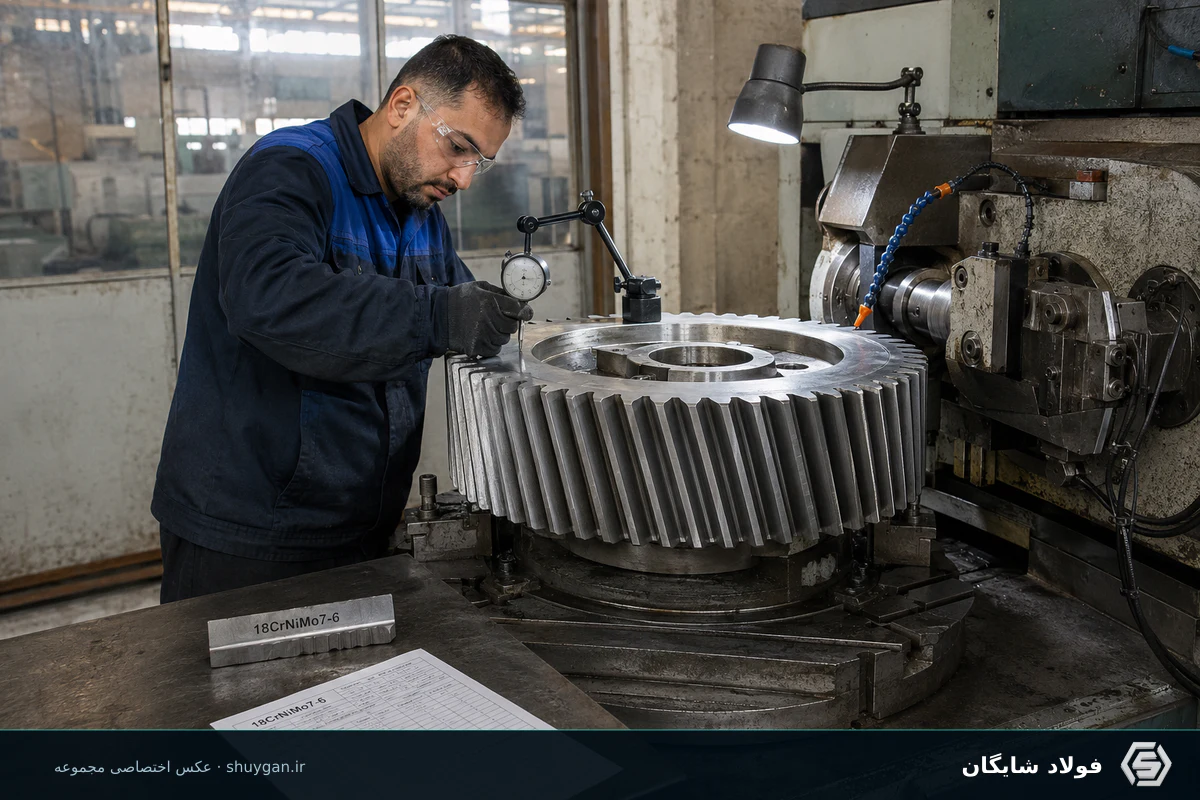
| Final surface verification | Grinding can remove case or create burn and cracks | Final profile, case-depth check, hardness traverse and NDT |
Identity, standard and the real engineering question
Total case depth describes the full chemically or microstructurally affected zone; effective case depth is defined by a specified hardness criterion. They are not interchangeable, and the drawing or process specification must state which one controls acceptance.
Build the machining allowance from the real error chain rather than applying one number to every face. Rough machining variation, heat-treatment growth, bow, ovality, straightening and grinding capability should each have an assigned allowance and datum.
Case-depth definition
Prevents total and effective depth from being mixed. Record Method, hardness limit, measurement direction and final location before commercial comparison begins. If this field remains verbal, purchasing, production and inspection can each interpret the same requirement differently.
Pre-carburizing stock
Provides material for decarburisation, distortion and finishing. The order should therefore require Allowance by surface, datum and process capability. Catalogue data becomes useful only after product form, section and test condition are made comparable.
Section, process and delivered condition
Section size changes cooling rate, property distribution, sampling position and sometimes the applicable property range. Product form also matters: bar, plate and forging may share a grade name but follow different dimensional, testing and delivery requirements.
Distortion is influenced by material cleanliness and segregation, residual stress from machining, asymmetric geometry, furnace loading and quench flow. Changing grade alone cannot compensate for an uncontrolled route.
Inspection evidence that closes the decision
Evidence should answer a defined question. An MTC records heat identity and declared results; a process record proves the route used; a supplementary test report proves a result at a stated location. None of them should be treated as a substitute for the other two.
Distortion route
Heating, phase change, quenching and geometry move dimensions. Define Datums, furnace support, quench method and straightening rule and identify the point where production must stop if the evidence is missing or outside the agreed range.
Final surface verification
Grinding can remove case or create burn and cracks. Release should be based on Final profile, case-depth check, hardness traverse and NDT, attached to the same heat and piece identity. A valid test report has limited conformity value after traceability has been lost.
A defensible purchase specification
State grade, initial condition, carburized and final dimensions, datum scheme, effective case-depth definition, surface and core hardness, grinding allowance by surface, distortion limits, coupon and final inspection.
Grade/material number: [complete]; standard and edition: [complete]; form and dimensions: [complete]; delivery condition: [complete]; quantity and cutting tolerance: [complete]; MTC type: [complete]; supplementary test and acceptance rule: [complete]. Topic-specific requirement: State grade, initial condition, carburized and final dimensions, datum scheme, effective case-depth definition, surface and core hardness, grinding allowance by surface, distortion limits, coupon and final inspection.
Ordering checklist for Tehran, Tabriz, Isfahan and Yazd
- Write the recognised market term, but place Case Depth and the documented designation on the same enquiry.
- Close Case-depth definition with Method, hardness limit, measurement direction and final location.
- Close Pre-carburizing stock with Allowance by surface, datum and process capability.
- Define Distortion route before irreversible processing.
- Keep Final surface verification traceable through cutting, storage and loading.
- State destination, required dispatch date, packaging, piece count and who authorises release.
Related encyclopaedia pages and guides
- 16mncr5 1 7131
- 18crnimo7 6 1 6587
- 18crni8 1 5920
- Previous Week-01 technical guide
- Next Week-01 technical guide
- Alloy-steel encyclopaedia
- Evidence and calculation methodology
- Contact Shaygan Steel
Frequently asked questions
Are total and effective case depth the same?
No. Effective depth uses a defined hardness criterion; total depth describes the full affected zone by another stated method.
What fixed grinding allowance should every tooth have?
There is no safe universal value. Use measured process capability, geometry, datum control and required remaining case.
Why can case depth fall after grinding?
Grinding removes material from the hardened profile; excessive stock removal can expose a shallower, softer part of the case.
Sources and method
This article uses the official references below as technical orientation and translates them into a procurement workflow for the Iranian market. A producer data sheet applies to the product and conditions it states; it does not replace the current purchase standard, drawing or MTC for the delivered heat.
- Ovako Steel Navigator — official technical reference
- Ovako Steel Navigator — official technical reference
- Ovako Heat Treatment Guide — official technical reference
Conclusion and next step
Design the final surface backwards: required case after finishing, expected grinding removal, distortion allowance and the pre-furnace geometry must form one controlled chain.
For an enquiry, send material number, form, raw and final dimensions, quantity, delivery condition, inspection needs and destination in one message. Shaygan Steel can then review the evidence for current stock before proposing a supply route.
Comments
Comments are published after moderation.