
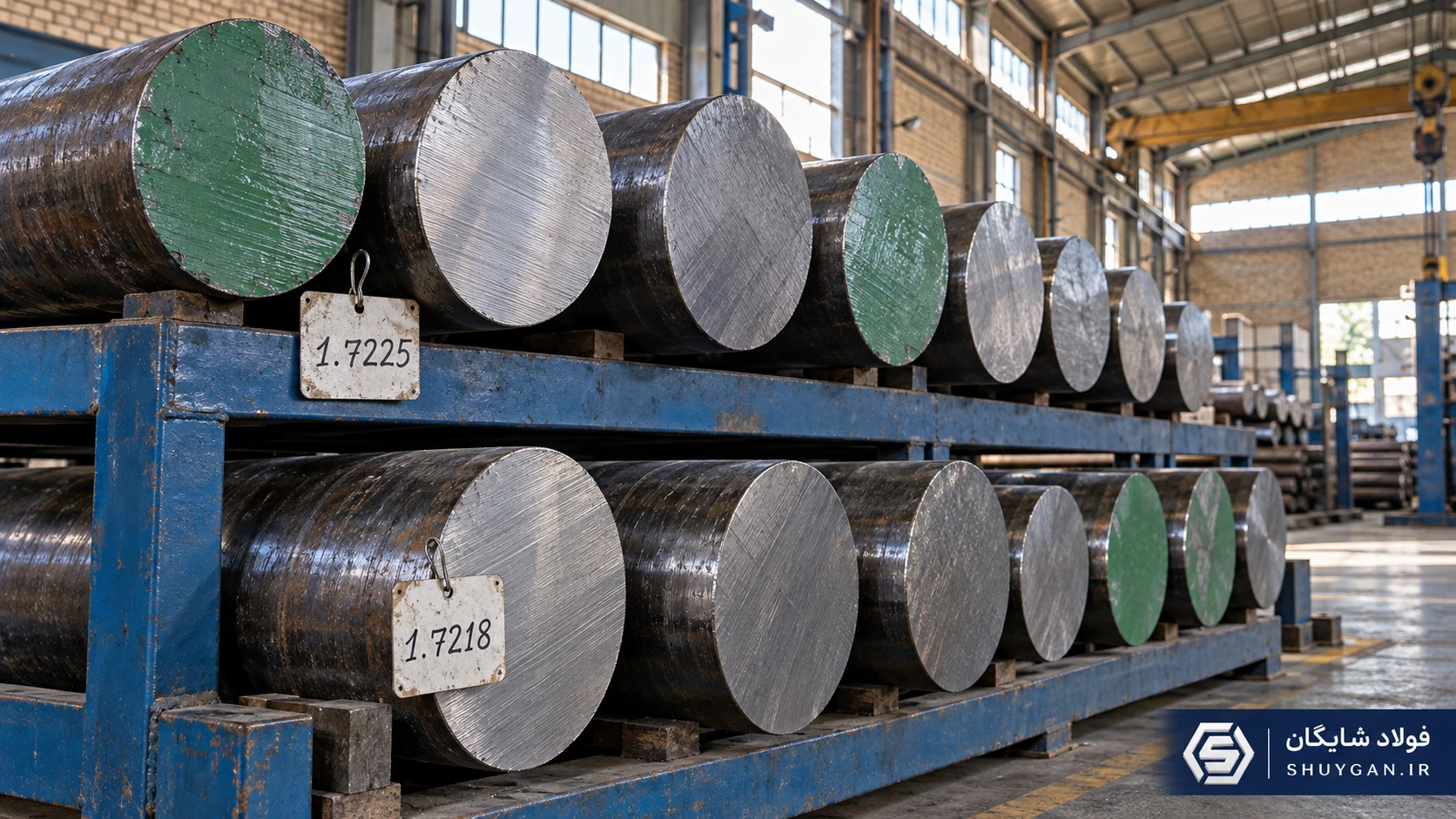
Two steel bars on a rack can look almost identical, yet one may suit your component while the other forces a change to its heat treatment or even its drawing. That is why the 42CrMo4 vs 25CrMo4 comparison matters: similar names and appearances do not mean identical manufacturing behaviour or service performance.
The short answer is that 1.7225, designated 42CrMo4, contains more carbon than 1.7218, designated 25CrMo4. Both are chromium-molybdenum steels suitable for quenching and tempering, but their attainable hardness, strength–toughness balance and welding considerations differ. A sound selection brings the grade, delivery condition, section size and component requirements together.
Start with an unambiguous steel designation
In the Iranian market, the material numbers are often shortened to 7225 and 7218. A formal order should include both the full number and the standard designation. MO40 is a familiar commercial name for 1.7225; some buyers also search for it as 4140. For 1.7218, the name 25CrMo4 appears alongside references to 4130 in some equivalence tables.
These associations help identify a neighbouring grade family, but they do not replace a specification review. Different standards can impose different chemistry limits, hardenability requirements, production conditions or tests. A close equivalent is therefore not automatically an approved substitute. If the drawing calls for 42CrMo4 and a supplier offers SAE 4140, conformity with the drawing must be established before purchase. The same principle applies to 25CrMo4 and SAE 4130.
| Common ordering name | Material number | European designation | Identification point |
|---|---|---|---|
| 7225, MO40 | 1.7225 | 42CrMo4 | State the grade and standard alongside the trade name |
| 7218 | 1.7218 | 25CrMo4 | Do not confuse it with 1.7131 or 16MnCr5 case-hardening steel |
The individual profiles are available in the 42CrMo4 / 1.7225 reference page and the 25CrMo4 / 1.7218 reference page. For an actual order, the agreed specification and the certificate covering the delivered material remain the acceptance references.
Chemical composition: carbon makes the main difference
The following table compares four key elements. Values are mass percentages, taken from the EN ISO 683-2 standard rows on Ovako's technical pages, rather than an analysis of a particular shipment. This is a comparison summary; other element limits and complete requirements must be checked against the agreed standard.
| Element | 1.7225 / 42CrMo4 | 1.7218 / 25CrMo4 |
|---|---|---|
| Carbon C | 0.38–0.45% | 0.22–0.29% |
| Manganese Mn | 0.60–0.90% | 0.60–0.90% |
| Chromium Cr | 0.90–1.20% | 0.90–1.20% |
| Molybdenum Mo | 0.15–0.30% | 0.15–0.30% |
Table sources: Ovako 42CrMo4 and Ovako 25CrMo4.
Chromium and molybdenum have matching ranges in these reference rows, whereas the carbon ranges are distinct. In practical terms, a quotation that says only “chromium-molybdenum steel” cannot establish that either material is suitable for the same manufacturing instruction. If an identification method reports the principal alloying elements but does not measure carbon, it leaves out a decisive part of this comparison.
Hardness and hardenability are different properties
Hardness describes local resistance to indentation. Hardenability concerns the ability to form a hardened structure through a section under specified cooling conditions. Two components may have similar surface hardness while their cores have developed different structures. This distinction becomes particularly important in large bars and components with abrupt thickness changes.
The higher carbon content of 7225 increases its potential to reach higher hardness after suitable hardening. Nevertheless, final hardness cannot be read from the grade name alone: initial condition, heating cycle, cooling severity and tempering all matter. Nor is a higher hardness automatically better. For an impact-loaded pin, sudden fracture may be much more costly than some additional wear.
The useful question is therefore not simply which steel can become harder. It is: at the required hardness, which grade can provide dependable properties in this component size and manufacturing route? A slender shaft and a large-diameter shaft may lead to different answers.
How to compare strength on a fair basis
A strength value is incomplete without a delivery condition. Soft-annealed, normalized, and quenched-and-tempered products of the same grade can behave differently. +QT denotes quenched and tempered material; +A denotes soft-annealed material. Comparing an annealed 7225 bar against a quenched-and-tempered 7218 bar is not a comparison of grade chemistry alone.
For one like-for-like example, Saarstahl's two data sheets give the following values for the +QT condition and the diameter band above 16 up to 40 mm. These are published manufacturer data, not unconditional guarantees for any material offered under the grade name. Contractual requirements and the relevant certificate govern an individual purchase.
| Property under the stated conditions | 42CrMo4 | 25CrMo4 |
|---|---|---|
| Minimum proof strength Rp0.2 | 750 MPa | 600 MPa |
| Tensile strength Rm | 1000–1200 MPa | 800–950 MPa |
| Minimum elongation A5 | 11% | 14% |
Sources: Saarstahl 42CrMo4 data sheet and Saarstahl 25CrMo4 data sheet. These sheets refer to DIN EN 10083. Do not combine them with the newer chemistry reference above as though they formed one contractual specification table.
The example helps explain why 7225 is considered for certain higher-strength applications. However, the higher elongation shown for 7218 does not automatically establish better fatigue life, better impact behaviour at every temperature or suitability for a welded assembly. Each property requires its own test and acceptance criterion. Values for this diameter band must not be applied directly to a 150 mm bar.
Shafts and pins need more than a tensile-strength number
In a rotating shaft, repeated loading, keyways, diameter transitions, surface finish and alignment can matter as much as the grade choice. If a crack starts at a sharp keyway corner, purchasing a steel with a higher strength number does not necessarily solve the geometry problem. First identify the likely limiting mechanism: yielding, fatigue, wear, impact, or a combination.
Consider a hypothetical design example: if a power-transmission shaft requires high core strength, quenched-and-tempered 42CrMo4 can be a candidate for evaluation. If a component must also meet welding or forming requirements, investigating 25CrMo4 may make more sense. Neither example authorizes a direct substitution; calculations, production requirements and designer approval are still needed.
Another distinction often lost in ordering is strength versus stiffness. A higher allowable strength does not imply a substantial reduction in elastic deflection at the same load and geometry. If shaft bending within the elastic range is the main problem, diameter, unsupported length and bearing arrangement need attention. Changing the steel designation alone is not a dependable remedy.
Welding: 7218 is often easier to manage, but not without controls
At an initial screening level, the lower carbon content of 25CrMo4 can make welding easier to manage than for 42CrMo4. However, “weldable” must not become permission to weld without a suitable procedure. Thickness, joint restraint, hydrogen, heat input and the base material's heat-treatment condition influence cracking risk and heat-affected-zone properties.
TWI describes carbon equivalent as a way of assessing composition-related behaviour in welding; the selected formula and its range of applicability also matter. A grade name or a generic number cannot produce one preheat temperature suitable for every component. Critical work needs a welding procedure and acceptance criteria appropriate to the actual joint. TWI explanation of carbon-equivalent formulae
Welding a +QT component raises another question: are the required properties retained near the joint after the thermal cycle? A visually sound weld bead does not answer that question. If fabrication or repair welding is planned, it belongs in the material-selection discussion from the beginning.
Machining, wear and corrosion are separate questions
For machining, actual hardness and delivery condition are more useful than a blanket statement that 7225 is harder to machine. Tooling, chip control, stock removal and workholding stability also affect production time and surface quality. Rough-machining before final heat treatment is a different route from machining purchased +QT stock directly to finished dimensions.
Wear assessment likewise begins with the type of contact. Sliding, rolling and abrasive-particle contact are not the same problem. Sometimes an appropriate surface treatment deserves investigation rather than an increase in through-section hardness. In other cases, the core must provide adequate support beneath the hardened surface. Treatment type and effective layer depth are design decisions, not consequences of a trade name alone.
Neither grade is stainless steel. Chromium in its composition does not make the material stainless. Warehouse humidity, storage and transport protection should be planned for the intended use. A clean or oiled surface is not, by itself, evidence of better chemistry.
Can 7218 replace MO40?
If a drawing or contract explicitly requires 1.7225, the purchasing answer is straightforward: do not change the grade without technical approval. If the design remains open, substitution can be evaluated, provided the required properties, dimensions, heat treatment, possible welding and acceptance tests are reviewed together.
The rule works in the other direction too. Buying 7225 instead of 7218 merely because it is thought to be “stronger” can create manufacturing or welding difficulties. Quality is fitness for a defined requirement. 7218 is not another name for low-quality 7225; it is a separate grade with its own chemistry and applications.
Frequently asked questions
What is the main difference between 7225 and 7218?
The principal chemistry difference in this comparison is carbon: 42CrMo4 contains more. The final choice, however, must use the product's properties at the required size and delivery condition rather than one element in isolation.
Can appearance or bar-end paint identify the grade?
No. Colour coding can support an individual warehouse's identification system, but there is no single universal paint code that conclusively distinguishes these two grades. Heat numbers, traceable markings and material documents matter.
Which grade is better for a shaft?
“Shaft” is not a complete application specification. Load, diameter, speed, notches, surface condition and required properties must be defined. 7225 can suit some higher-strength requirements; that does not justify selecting it without design checks.
Is 7218 the same as case-hardening steel 7131?
No. 1.7218 designates 25CrMo4 and must not be treated as 1.7131 / 16MnCr5. Similar numbers do not establish a shared specification or interchangeability.
Can a hardness test prove which grade is present?
No. Hardness depends on both composition and thermal history, and hardness ranges can overlap. Grade identification requires suitable chemistry verification alongside material traceability.
Turn component requirements into an order specification
Before requesting a quotation, record four items together: complete grade, standard, delivery condition and dimensions. Then add the properties or tests actually required by the drawing. This is much easier to control than asking for “a good chromium-molybdenum bar.”
The companion 7225 and 7218 purchasing and manufacturing guide follows this process from quotation through cutting and delivery. To discuss supply availability and cutting to order, use the Shaygan Steel contact page and include the relevant component information. Shaygan Steel: the right choice in alloy steel.
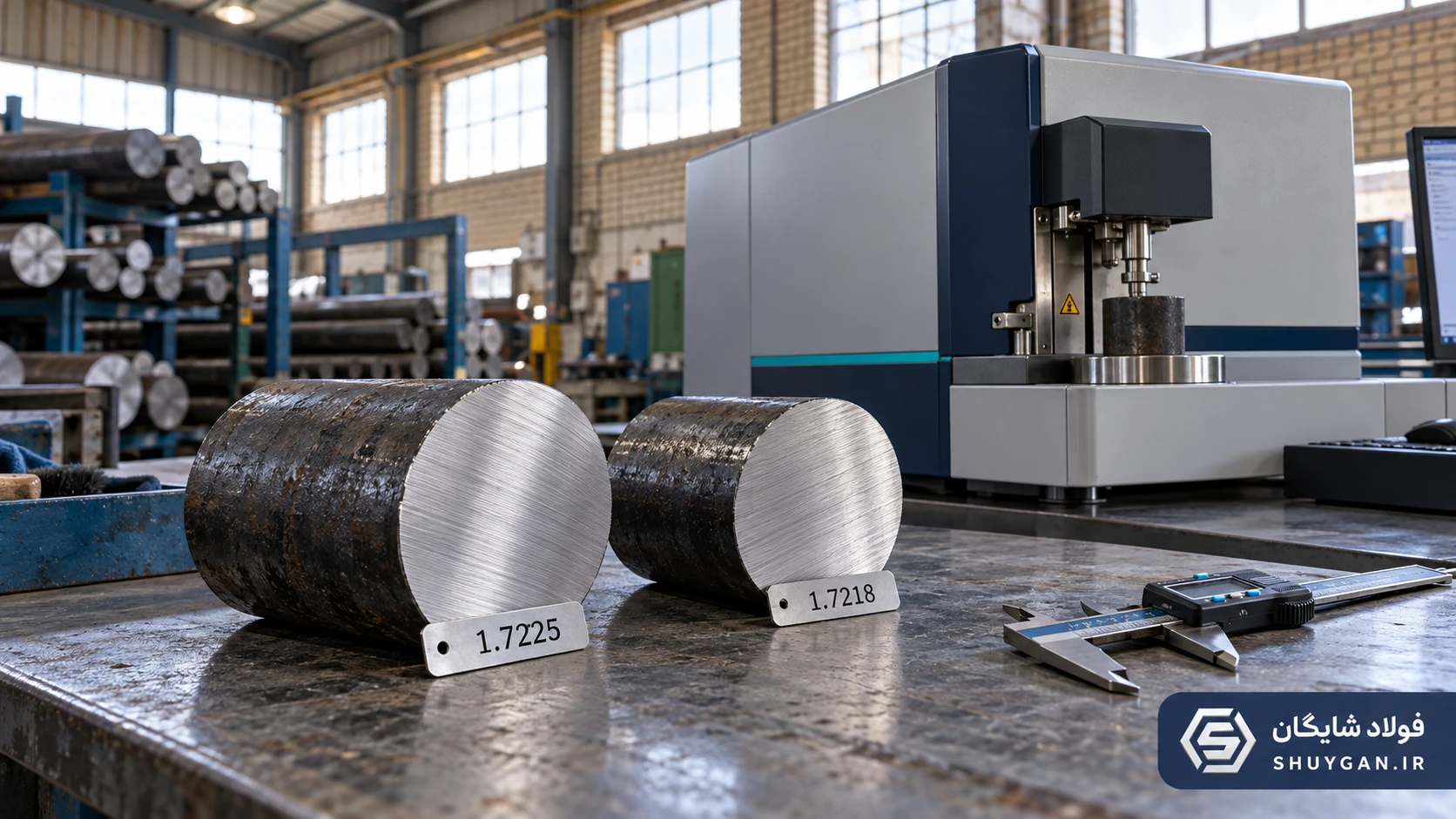
The images in this article are educational illustrations, not photographs documenting actual stock, a material certificate or shipment test results.
Comments
Comments are published after moderation.